Be yourself; Everyone else is already taken.
— Oscar Wilde.
This is the first post on my new blog. I’m just getting this new blog going, so stay tuned for more. Subscribe below to get notified when I post new updates.
Be yourself; Everyone else is already taken.
— Oscar Wilde.
This is the first post on my new blog. I’m just getting this new blog going, so stay tuned for more. Subscribe below to get notified when I post new updates.
By: Emily Purnell
INTRODUCTION:
Picture this, you’re in your 7th math class and the teacher hands you a paper with numbers and letters on it. You have no idea what to do and your think this is completely unreasonable. Why am I going to need to this? Through the elementary school days, we learned basic math, adding, subtracting, times tables, etc. These were all of the essential things we thought we would need to know. Little did we know, we were absolutely WRONG. As soon as we walk into middle school, our ideas of math completely change. Assignment after assignment, test after test, throughout middle and high school, we come to think why and when are we ever going to use this information?
I used to think this way and honestly sometimes, I do. However, as I get older and as I am being exposed to bigger things in the world then the generic classroom with four white walls plastered with inspirational math posters, I am discovering that math has a big impact on our lives and is very important.
HOW DOES ALGEBRA HELP WITH MENTAL HEALTH?
Even though you think algebra is stressful in the moment, it pays off in the long run and has the ability to help students. Algebra problems are mostly all memory based and this means, and this can is great for students growing and developing cognitive minds and also help with emotional health.
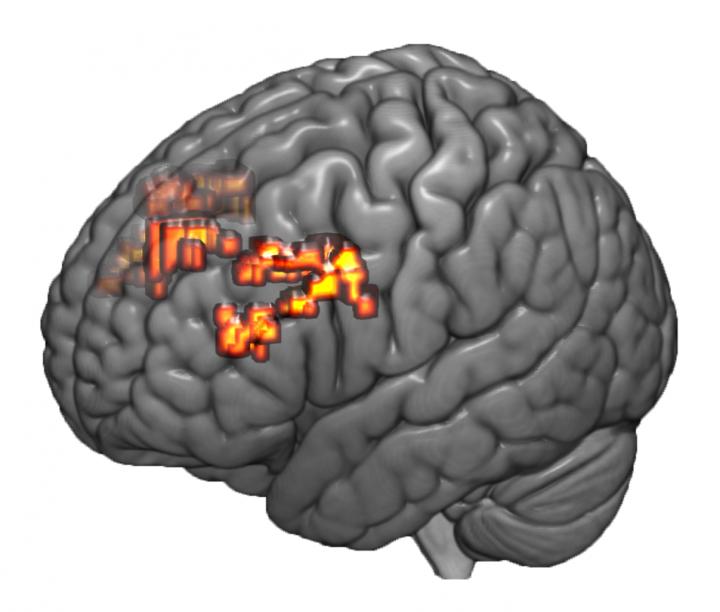
Duke University released their research and analysis on algebra and how it effects emotional health. Duke researchers state their analysis in the journal of Clinical Psychological Science, “Engaging a specific part of the brain during mental math exercises is connected with better emotional health.” With memory based math, it effects a part of the brain, which is also associated with depression and anxiety. With these two factors, Duke researchers found that inducing this part of the brain with mental math can reduce chances of depression and anxiety.
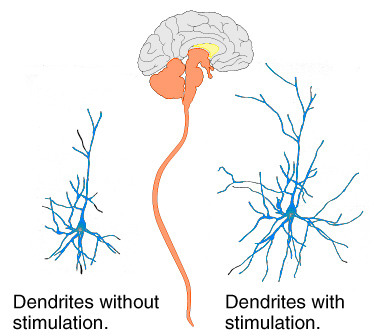
Algebra effects our brain so much and our mental mind. Through algebra, it can help with development and strengthening the brain.Our brain has something called dendrites and when our brain is solving a problem, they are stimulated causing them to grow and making connections throughout our whole brain. Our brain is like a muscle and when our brain is active and thinking about how to solve a algebra problem, it is making our brain/muscle stronger.
“Learning algebra isn’t about acquiring a specific tool; it’s about building up a mental muscle that will come in handy elsewhere.” (Steve Johnson; Everything Bad is Good for You)
WHERE CAN WE GO WITH ALGEBRA LATER IN LIFE?
We spent what seems like an endless amount of time focusing on math homework and we figure we will never see this again or need it again later in life. That’s not the case. Algebra has gateway math equations that can be applied to higher levels of math when a student moves into other levels of math. Math can be applied to so many things long after your schooling is done. Many jobs seek for proficiency in math skills and a mathematic background can make a resume very marketable.
FAST FACTS
According to Renaissance, “In addition, algebra/geometry, intermediate algebra, advanced algebra, and calculus all appeared to increase earnings more than average-level English courses did.”
Like I said before, algebra is a gateway skill that opens up levels for higher math levels that can lead into higher chances of succeeding in high school, college and even later career paths. Past president of the National Council for Teachers of Mathematics, Matt Larson states, “Algebra is critically important because it is often viewed as a gatekeeper to higher-level mathematics and it’s a required course for virtually every postsecondary school program.” From Renaissance’s article, Math milestones: The critical role of math achievement in student success, it supports this Larsons statement by explaining, “Students who had completed a calculus course earned 65% more than students whose math education did not progress past a vocational math course.”
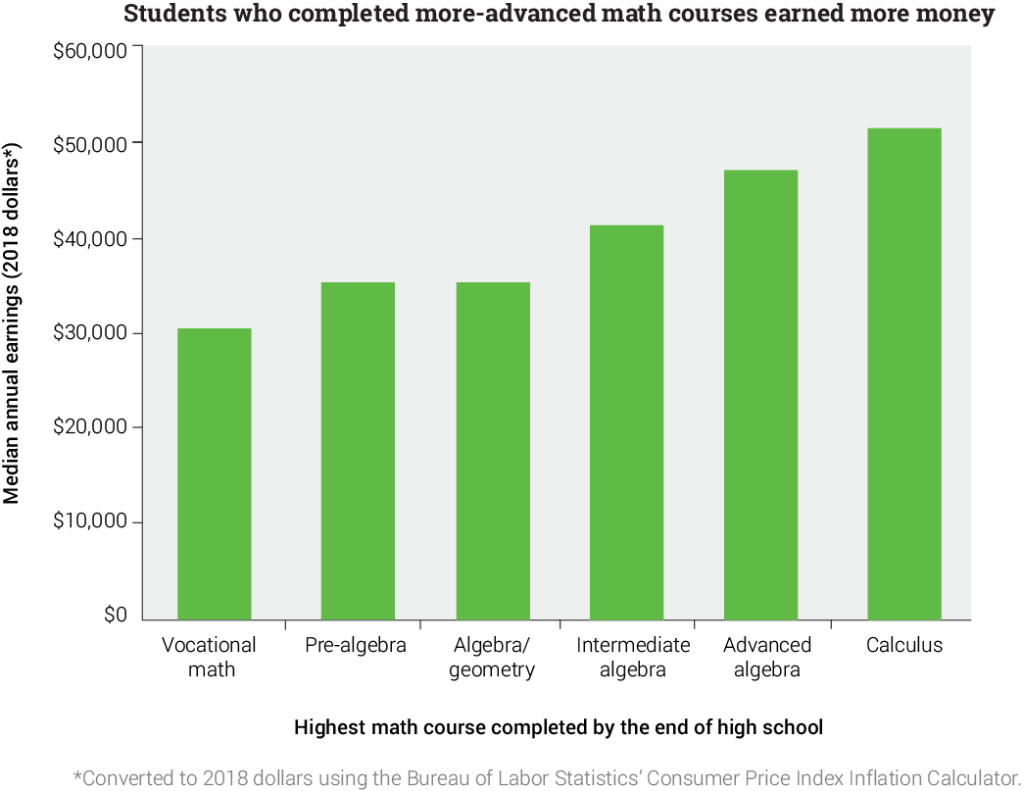
This bar graph shows how math connecting to the outside world is like a domino effect. Starting with basic math, then working its way up to algebra, then leads and opens up into higher levels of mathematics like calculus. As the level of math increases, so does the annual income. This shows how algebra can certainly pay off in the end and lead into bigger things later in life.
HOW CAN WE USE ALGEBRA IN EVERYDAY LIFE?
Algebra can be applied to so many aspects of life outside of the classroom. Even the simplest of tasks could require you to use algebra. Something as simple as setting your alarm clock the night before, you are thinking of how much time you need to give yourself in order to get ready and be ready to go on your way for the day. Algebra has such a wide variety of impacts that you may have never thought about.
One example of how algebra can be used in everyday life could be for sports. As simple as it might sound, but shooting a basketball at a net requires mathematical reasoning. Consciously, we know how much arch and speed we have to shoot the ball, but behind that there is madness. Algebraically, shooting a basketball takes a lot more than estimating these things. We have to use the vertical motion formula to find the arch. To find the speed of the ball to hit the net, we have to use the quadratic formula.
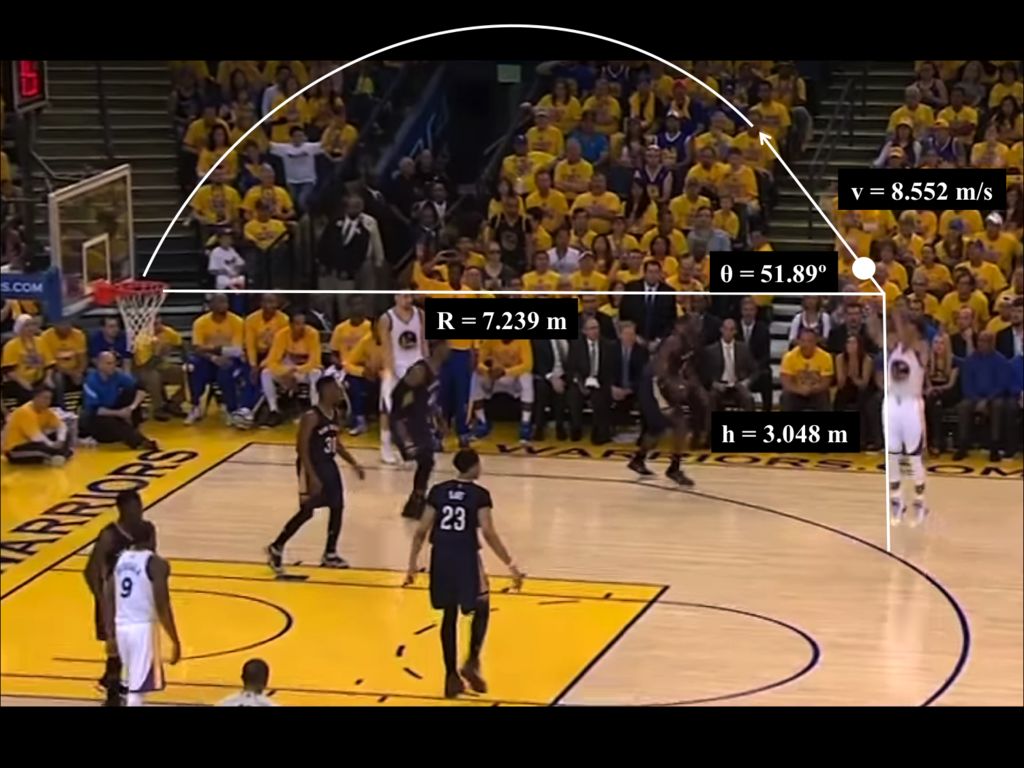
Another example of how algebra is used in everyday life, is through finances. It might not sound better than math in school, but it is such a crucial and necessary thing we are going to eventually going to need to know how to do. Under this category, we need to know how to balance our checkbooks, and use algebraic equations in order to know our costs and needs.
There is also the fact of building a home or decorating. Without the knowledge of algebra, we wouldn’t be able to figure out how to make calculations to hang up a picture, knowing how much carpet your space needs, or finding out how big your walls are to estimate how many paint buckets you are going to need to cover them.
These were just a few examples of how we use algebra in everyday. They can be so simple, however they are relevant to everybody.
IN CONCLUSION…
Algebra is important for so many reasons even when you don’t want to do another problem, worksheet or test. Algebra helps in so many ways from your mental health, to your professional career, to even everyday activities. The algebra section in your textbook has so many more pages to follow with you in life. So next time you’re feeling down, thinking about your future, or even painting your house, remember what can help you… algebra.
CITATIONS
Bates, K. (2016, October 10). Could Mental Math Boost Emotional Health? Retrieved from https://today.duke.edu/2016/10/could-mental-math-boost-emotional-health.
DukeU. (2016, October 10). Could mental math boost emotional health? Retrieved from https://www.eurekalert.org/pub_releases/2016-10/du-cmm101016.php.
Math milestones: The critical role of math achievement in student success. (2019, July 29). Retrieved from https://www.renaissance.com/2018/03/22/blog-math-milestones-critical-role-math-achievement-student-success/.
Why Are We Learning This? Teaching Algebra for Everyday Life. (2019, August 13). Retrieved from https://blog.planbook.com/teaching-algebra/.
Why Learn Algebra? A Discussion of the Benefits of Learning Algebra. (n.d.). Retrieved from https://www.mathmedia.com/whystudal.html.
This is an example post, originally published as part of Blogging University. Enroll in one of our ten programs, and start your blog right.
You’re going to publish a post today. Don’t worry about how your blog looks. Don’t worry if you haven’t given it a name yet, or you’re feeling overwhelmed. Just click the “New Post” button, and tell us why you’re here.
Why do this?
The post can be short or long, a personal intro to your life or a bloggy mission statement, a manifesto for the future or a simple outline of your the types of things you hope to publish.
To help you get started, here are a few questions:
You’re not locked into any of this; one of the wonderful things about blogs is how they constantly evolve as we learn, grow, and interact with one another — but it’s good to know where and why you started, and articulating your goals may just give you a few other post ideas.
Can’t think how to get started? Just write the first thing that pops into your head. Anne Lamott, author of a book on writing we love, says that you need to give yourself permission to write a “crappy first draft”. Anne makes a great point — just start writing, and worry about editing it later.
When you’re ready to publish, give your post three to five tags that describe your blog’s focus — writing, photography, fiction, parenting, food, cars, movies, sports, whatever. These tags will help others who care about your topics find you in the Reader. Make sure one of the tags is “zerotohero,” so other new bloggers can find you, too.
Have a WordPress.com account? Log in now.

